
For your business
Commercial solar PV
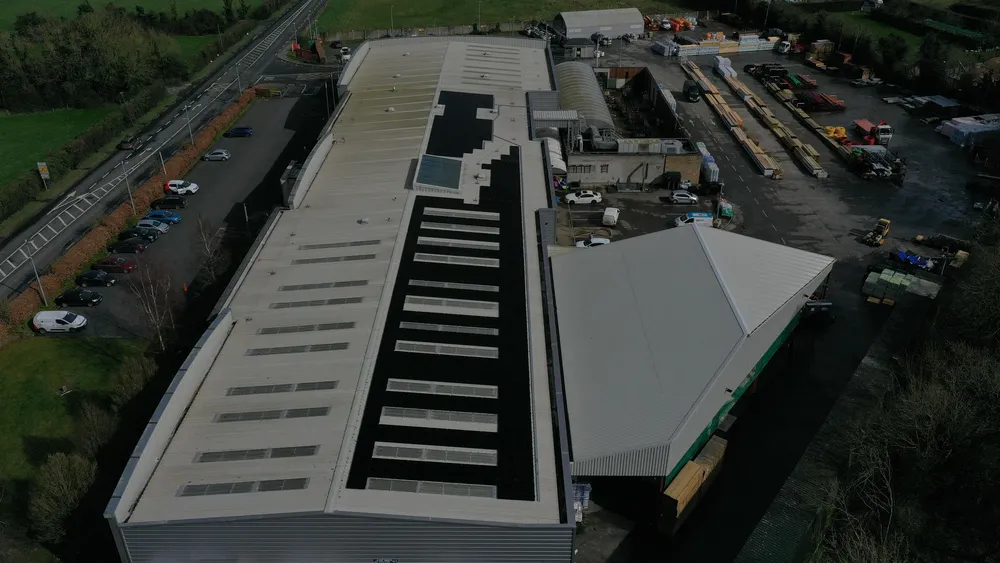
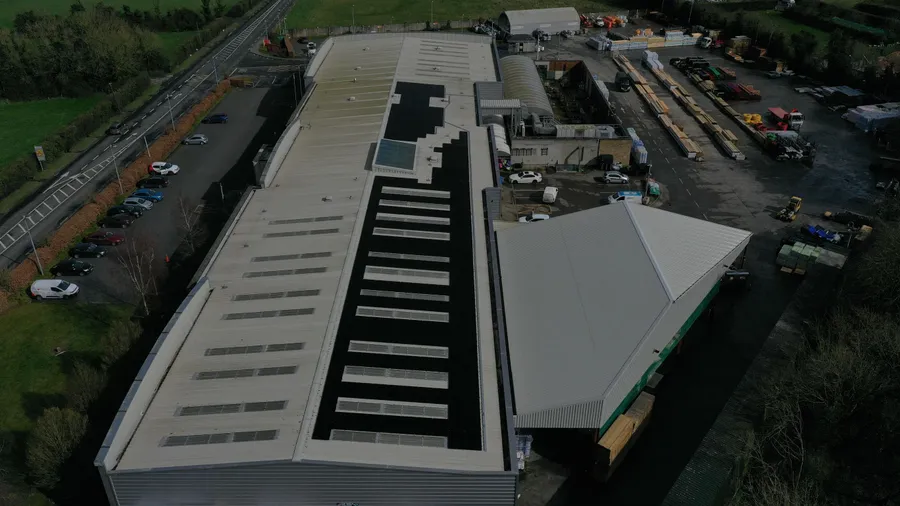
Large roofs are usually a business’s most underused asset. We turn them into a long-term hedge against electricity prices, designed and phased around your operations.
- Up to €162,600 grant
- Systems to 1 MWp
- Minimal operational disruption
Accredited & registered Athlone · Installing solar since 2013 (13 years)
 SEAI Registered
 Safe Electric
 Solar Ireland Member
 Athlone Chamber
Why it works on commercial roofs
Your demand curve already matches solar’s
Most businesses draw their heaviest load during the working day. That is when a solar array produces.
It is the single biggest advantage commercial solar has over domestic. A house is often empty when generation peaks; a factory, warehouse, workshop or office is not. Refrigeration, compressed air, ventilation, lighting and machinery all run through the middle of the day, so a high proportion of what the system generates is consumed on site.
Self-consumption is what determines the return. Units you use displace electricity you would have bought at your full commercial unit rate. Units you export earn considerably less. So we design to maximise the units you use.
- Large, uninterrupted roof planes suit big arrays and simple mounting
- Single-storey industrial roofs are usually straightforward to work on safely
- Existing three-phase supply and board capacity often already suit a sizeable system
- Daytime load means high self-consumption without needing storage
Grant support
The Non-Domestic Microgen Scheme
SEAI supports non-domestic solar up to 1000 kWp, with a maximum grant of €162,600. Support is tiered: the rate per kWp steps down as the system gets larger.
Maximum grant
€162,600
Maximum system size
1000 kWp
1 MWp
Rate structure
Tiered
Per-kWp rate reduces as size increases
Who can apply
Broad
Business, farm, school, public body, non-profit
On the per-kWp band table
We do not publish a band table here because SEAI revises the bands periodically, and an out-of-date table sets an expectation we would then have to walk back. We work out your entitlement against the current SEAI scheme rules as part of the quotation, and show you the calculation. As a sense of scale: support runs from the low thousands for a small rooftop system into six figures for the largest, with the €162,600 maximum applying at 1000 kWp.
Accelerated Capital Allowances: the timing point
For a trading company the grant is usually not the only support that moves the numbers. Under the Accelerated Capital Allowances (ACA) scheme for energy-efficient equipment, a company can write the qualifying cost of the system, meaning the net cost after any grant, off against its taxable profits in year one; the standard treatment spreads it across an eight-year write-down for plant and machinery.
Two things about that get lost in the sales version. First, ACA is a timing benefit: you claim the same total allowances either way, it just brings the relief forward. Second, it is only worth something to a company with taxable profits to set it against this year.
The qualifying conditions, the eligible-equipment criteria and the scheme’s end date are set in legislation and revised periodically, so confirm the current position with Revenue or your accountant before you count on it. We are solar engineers: we set out the specification and the net cost after grant clearly, and leave the tax assessment to your accountant, who can model it against your circumstances.
Planning is rarely the obstacle people expect
Since October 2022, rooftop solar on industrial, commercial and agricultural buildings is exempt from planning permission without an area cap, outside a small number of Solar Safeguarding Zones near airports. Protected structures and ground-mounted arrays have separate rules. We confirm the planning position for your specific site as part of the survey. In most cases no application is needed.
How a commercial project runs
Phased around your operations
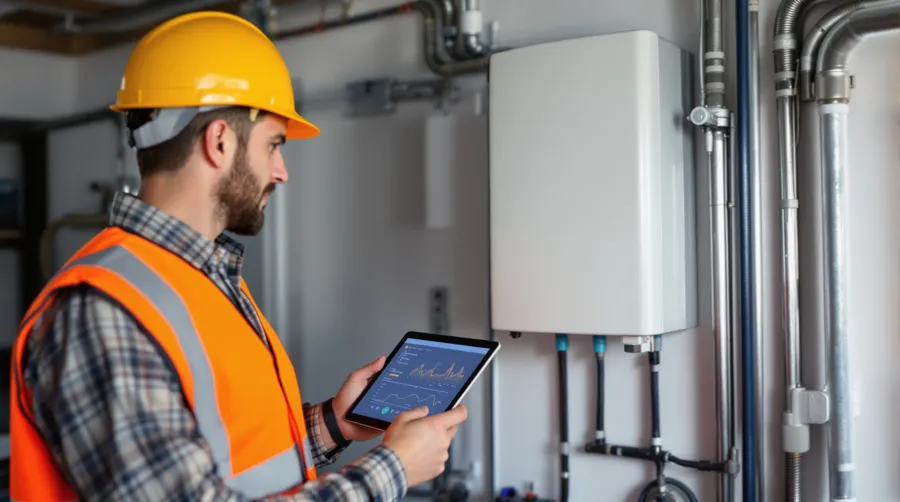
The concern we hear most often is disruption. A commercial installation is largely roof work, and on a single-storey industrial building most of it happens well away from your floor. The parts that do touch your operation — the electrical connection and commissioning — are short, planned in advance and scheduled around you.
- Structural and roof condition assessment before anything is committed
- Load profile analysis from your half-hourly data where available
- System design and yield modelling for your specific roof geometry
- Grid application, where sizeable systems need network agreement and lead times matter
- Grant application guided, with the supporting documentation prepared by us
- Installation phased to avoid your peak periods
- Commissioning, monitoring setup and staff handover
- Ongoing servicing under a maintenance agreement
Larger projects are where we are strongest
We work across the full range, but complex commercial and industrial installations are where our engineering background earns its keep: multi-roof sites, phased rollouts, and systems that need careful grid coordination.
Track record
Organisations we have worked with





If capital is the obstacle
You do not have to fund it yourself
Where the business case works but the capital budget does not, a Power Purchase Agreement is worth looking at. We fund, install, own and maintain the system, and you buy the electricity it produces.
It is not automatically the better option; owning the asset outright is usually stronger over the full life if you can fund it. But for organisations that cannot commit capital, or want it working elsewhere, it turns a capital decision into an operating one.
Good to know
Common questions
The things people ask us most about commercial solar PV installation.
Who handles the grant paperwork for a farm or business project?
It depends which scheme you are under. For TAMS, your farm advisor lodges the application and we supply the system specification, quotes and documentation it needs. For the SEAI Non-Domestic Microgen Scheme, the application is made before work starts and we provide the installer detail and the completion documents that release the payment. Either way, no work should start before approval is issued. That means TAMS approval from the Department of Agriculture, or the SEAI letter of offer, and we make sure that order is kept.
What grant support is available for a business?
The SEAI Non-Domestic Microgen Scheme supports non-domestic solar installations up to 1000 kWp, with a maximum grant of €162,600. Support is tiered by system size, so the rate per kWp reduces as the system gets larger. Businesses, farms, schools, public sector bodies, community groups and non-profits can all apply.
Can a business claim the SEAI Non-Domestic grant and use a PPA?
Not both for yourself. The grant follows whoever owns the system, so you cannot claim it on an array someone else has funded. Under a Power Purchase Agreement the provider owns the system and claims the SEAI Non-Domestic Microgen Scheme, worth up to €162,600, and that value should show up in the unit rate you are quoted. It is one reason buying outright is usually the stronger option where the capital is available: you keep the grant, the system itself and all of the electricity. Ask any PPA provider, ourselves included, to show you how the grant is carried through into the rate.
Do I need planning permission for solar panels?
Usually not. Rooftop solar on houses is exempt from planning permission, with no area limit, since October 2022 — and that applies anywhere in the country, including inside the 43 Solar Safeguarding Zones around airports and aerodromes, which cap other kinds of building but not houses. The exceptions for a house are protected structures and Architectural Conservation Areas. Rooftop solar on industrial, commercial and agricultural buildings is exempt from planning permission with no area cap outside the 43 Solar Safeguarding Zones near airports and aerodromes. Inside a zone, the exemption for these buildings stops at 300m² of panels — counting anything already installed — so a larger array needs permission. Ground-mounted arrays and protected structures have separate rules, and we confirm the position for every site as part of our survey.
How long does an installation take?
A typical domestic installation is completed in a small number of days on site once the system is designed, the grant offer is in place and materials are scheduled. Commercial and farm projects run longer and are phased around your operations. We give you a specific timeline in your quotation rather than a generic estimate.
Can you install charge points at a workplace?
Yes, and several points is a different job to one home charger. Total site capacity, dynamic load sharing across the points, access control and per-user usage reporting all have to be designed together rather than installed one at a time. Workplace charging pairs well with a commercial array, because staff cars are parked on site during the daytime hours when the system is producing, so more of the generation gets used on site.
What happens to the electricity I do not use?
You have three options and most systems use all of them: use it in the building as it is generated, store it in a battery for later, or export it to the grid. Exported electricity is paid for by your supplier under the Clean Export Guarantee. The rate you receive is set by your electricity supplier, so it is worth comparing.
What areas do you cover?
We are based in Blyry Business & Commercial Park in Athlone and work across the Midlands and nationwide. Athlone, Mullingar, Tullamore, Longford, Ballinasloe, Roscommon and the surrounding counties are our home patch, and we travel further for commercial and farm projects.
Explore
Other things we do
Most systems we install combine more than one of these. We design them together rather than bolting them on afterwards.
Solar PPA
Zero upfront cost. We fund, install, own and maintain the system, and you buy the power it produces.
Learn more
Battery Storage
Keep the electricity you generate instead of exporting it, and hold power in reserve for outages.
Learn more
Solar Maintenance & Support
Inspections, monitoring and repairs that keep a system performing across its warranted life.
Learn more
Get started
Let’s look at your roof and your load profile
Send us a recent electricity bill and we will come back with an assessment of what your building could support and what it would realistically displace.