
For your home
Solar panels for your home
A system sized to how your household uses electricity, with the SEAI grant guided from eligibility check to completion documents.
- €1,800 SEAI grant
- Free site survey
- Battery and EV ready
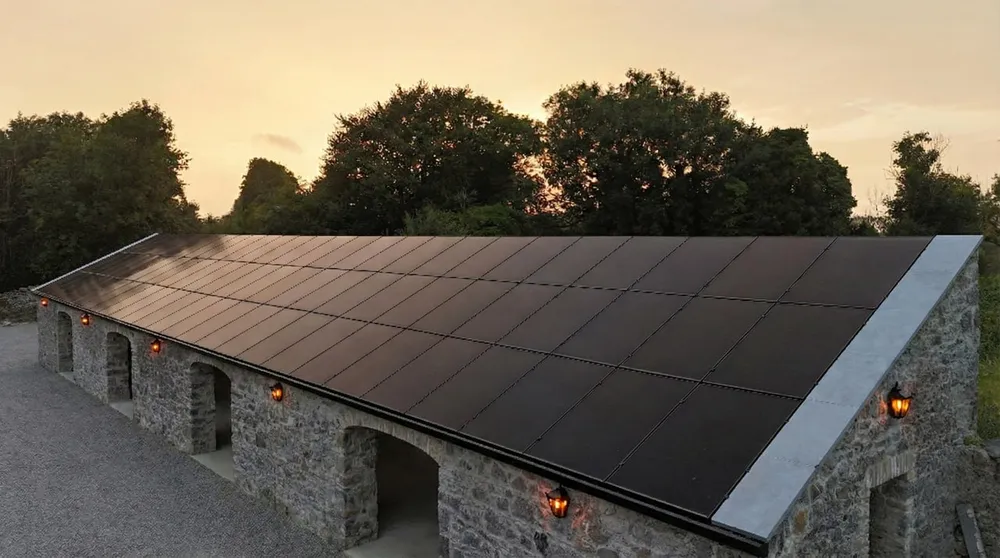
Accredited & registered Athlone · Installing solar since 2013 (13 years)
 SEAI Registered
 Safe Electric
 Solar Ireland Member
 Athlone Chamber
The starting point
Designed for payback
Most people go solar to save money. So the design target is simple: the strongest payback we can get for your house, with the assumptions shown.
We start with your bills. A unit you use in the house is worth what you would have paid your supplier for it; a unit you export earns meaningfully less. Two identical systems on two identical roofs can pay back years apart depending on when each household uses its power. So we design around your pattern, and show you the payback calculation before you sign anything.
The first thing we ask for is a recent bill and a sense of your daily routine. A household with someone home during the day, an electric car, or a heat pump has a very different profile to one that is empty from eight until six, and the right system differs with it.
If the house is empty during the day
This is the most common situation we see, and it is the clearest case for adding storage. A battery holds your midday generation for the evening, so you buy fewer units back. We model it against your consumption before we recommend one.
Grant support
The SEAI Solar PV Grant, in plain terms
Worth up to €1,800. You apply to SEAI for the grant offer. We check your eligibility first, give you every detail the application asks for, and handle the installer, grid-notification and completion documents. We also mind the sequencing, which is where valid claims most often get lost.
First 2 kWp
€700 per kWp
Each additional kWp
€200 per kWp
Up to 4 kWp
Maximum grant
€1,800
VAT on domestic solar
0%
Applies to supply and installation
What that works out at
- 2 kWp€1,400
- 3 kWp€1,600
- 4 kWp or larger€1,800
Above 4 kWp the grant does not increase. A larger system can still make sense, but the extra capacity has to be justified by your consumption.
To qualify, you need
- Your home is in Ireland and was built and occupied before 1 January 2021
- You have a BER assessment on file — there is no minimum rating required
- The installation is carried out by an SEAI-registered installer
What we install
What a domestic installation includes
Every quote we issue names the equipment: manufacturer, model and rating, never “tier 1” or “premium”. You should know exactly what is going on your roof before you sign anything.
- Full roof, shading and structural assessment at survey
- System design sized to your consumption pattern
- Glass-glass panels only, with a 30-year performance warranty. The quotes customers bring us usually specify the cheaper glass-foil construction; your quote names the product warranty too
- Inverters and batteries warranted for 10 years or more, named by manufacturer and model in your quote
- Installed by our own in-house crews. We do not subcontract your roof to anyone
- Optional battery storage, sized against your evening load
- Optional EV charger, specified as part of the system design
- All electrical work by a registered electrical contractor
- Grid connection application and registration handled by us
- SEAI grant application guided, with the installer and completion documents submitted by us
- Monitoring set up so you can see production from your phone
- Handover, with the paperwork and warranties collected in one place
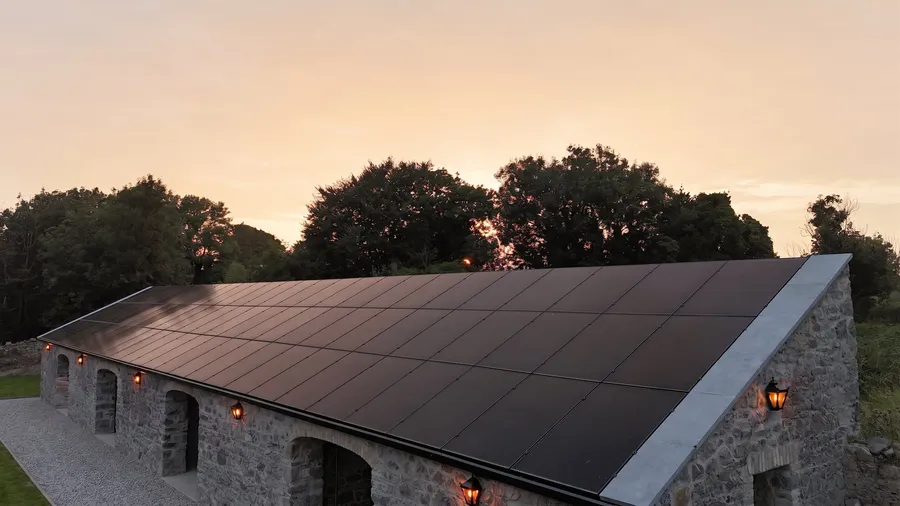
This is why we are careful about promises. An Irish system produces plentifully for two thirds of the year and very little in December. A good design works with that curve — anyone quoting you a flat monthly saving is not.
The numbers
Home solar in Ireland — the current figures
The figures every projection should be built on, each one labelled for what it is. Prices and rules come from named sources; generation and export figures are the planning ranges we use for sizing. Reviewed 25 July 2026.
What you pay for electricity
~40c/kWh
Irish households now pay the highest household electricity price in the EU, around 40% above the EU average (Eurostat, H2 2025)
What a Midlands roof generates
850–900 kWh per kWp per year
Planning range: a 4 kWp system typically produces 3,400–3,600 kWh/year. Orientation, pitch and shading move it either way.
What exported units earn
15–20c/kWh
First €400/year of export income is tax-free until the end of 2028
Planning permission
Not needed
For rooftop solar on houses, with no area limit, since October 2022
System price
Quoted from a survey
Every quote follows a survey and names the exact equipment and exact price, with the €1,800 grant and 0% VAT shown.
Payback
Calculated for your house
Your quote includes the payback calculation for your house, with every assumption written down
Rooftop solar on houses is exempt from planning permission, with no area limit, since October 2022 — and that applies anywhere in the country, including inside the 43 Solar Safeguarding Zones around airports and aerodromes, which cap other kinds of building but not houses. The exceptions for a house are protected structures and Architectural Conservation Areas. Standard CEG rates in mid-2026 cluster between about 15c and 20c per kWh. Rates differ by supplier and change through the year — check your supplier’s current rate.
The limits
What solar will not do
Winter bills do not disappear
Ireland sits at a northern latitude, so generation is strongly seasonal: plentiful in summer, limited in midwinter. A well-sized system substantially reduces your annual purchased electricity, with most of the saving coming in the brighter two-thirds of the year.
Backup in a power cut needs extra equipment
Backup during an outage requires specific equipment and additional wiring so the system can safely disconnect from the grid. It is not included by default. If outage protection matters to you, say so at the outset and we will specify for it.
Plan for one inverter replacement
Panels are long-life equipment, but inverters have a shorter service life and should be expected to need replacement at least once over a thirty-year system life. A projection that shows decades of operation with no inverter replacement is leaving a real cost out.
Good to know
Common questions
The things people ask us most about domestic solar PV installation.
How much is the SEAI solar grant for a home?
The SEAI Solar PV Grant is worth up to €1,800. It is paid at €700 per kWp for the first 2 kWp installed, then €200 for each additional kWp up to 4 kWp. So a 2 kWp system gets €1,400 and a 4 kWp or larger system gets the full €1,800.
Is my home eligible for the SEAI grant?
Your home needs to be in Ireland and to have been built and occupied before 1 January 2021. You need a BER assessment on file (there is no minimum rating), and the work has to be carried out by an SEAI-registered installer. Lumen Solar is an SEAI-registered Solar PV company, so your installation qualifies. One thing to watch: you have 8 months from grant approval to complete the installation, so apply when you are ready to go ahead, not just to see what you would get.
Do you handle the grant paperwork?
We guide you through it. You apply to SEAI yourself. It is a short online application, and we give you every detail it asks for. We then handle the installer declarations, the ESB Networks notification and the completion documents that release the payment. No work should start before your grant approval is issued, and we make sure that order is kept right.
What does home solar actually cost?
It depends on the roof and the equipment, which is why we quote from a survey rather than a price list. Domestic solar is zero-rated for VAT until at least 31 December 2026, and the €1,800 SEAI grant comes off what you pay. Your quotation names the exact equipment and the exact price, with the payback calculation and its assumptions written down.
Is the grant deducted from the price, or paid to me?
For the domestic SEAI grant, the money is normally paid to you by SEAI after the installation is completed and the post-works documentation, including the BER assessment, has been submitted. Your quotation from us shows the full price and the grant separately, so it is clear what you pay and what comes back.
How do I get paid for electricity I export?
Export payments come from your electricity supplier under the Clean Export Guarantee, not from the government. When we commission your system we notify ESB Networks (the NC6 or NC7 form), which is what registers you as a microgenerator; your supplier then applies its export rate to your account. With a smart meter your actual export is measured; rates vary by supplier, so it is worth comparing. The first €400 a year of export income is exempt from income tax, an exemption currently legislated to the end of 2028.
How big a battery does a typical house need?
Enough to cover your evening and overnight consumption, and not much more. Capacity you cannot cycle daily earns nothing. For many Irish homes that lands somewhere between 5 and 15 kWh, but the real answer comes from your consumption pattern, which is what we model at survey stage before recommending a size.
Does solar affect my BER or my house insurance?
Solar PV normally improves a BER, because it reduces the calculated primary energy use of the home, and a post-works BER assessment is part of the SEAI grant process anyway. On insurance, tell your insurer you have added solar, as with any alteration to the building. Cover for panels is routine.
Explore
Other things we do
Most systems we install combine more than one of these. We design them together rather than bolting them on afterwards.
Battery Storage
Keep the electricity you generate instead of exporting it, and hold power in reserve for outages.
Learn more
EV Charging
Charge from your own roof or off-peak night rates, with a charger properly integrated into your system.
Learn more
Solar Maintenance & Support
Inspections, monitoring and repairs that keep a system performing across its warranted life.
Learn more
Get started
Find out what your roof could do
Book a free site survey. We will tell you what we would install, what it would generate, and whether it is worth doing at all.